

- 홈
- Introduction
Introduction
Introduction
INTRODUCTION
CFD Laboratory
전산열유체 연구실 · Major of Mechanical System Engineering, College of Engineering, Pukyong National University
|
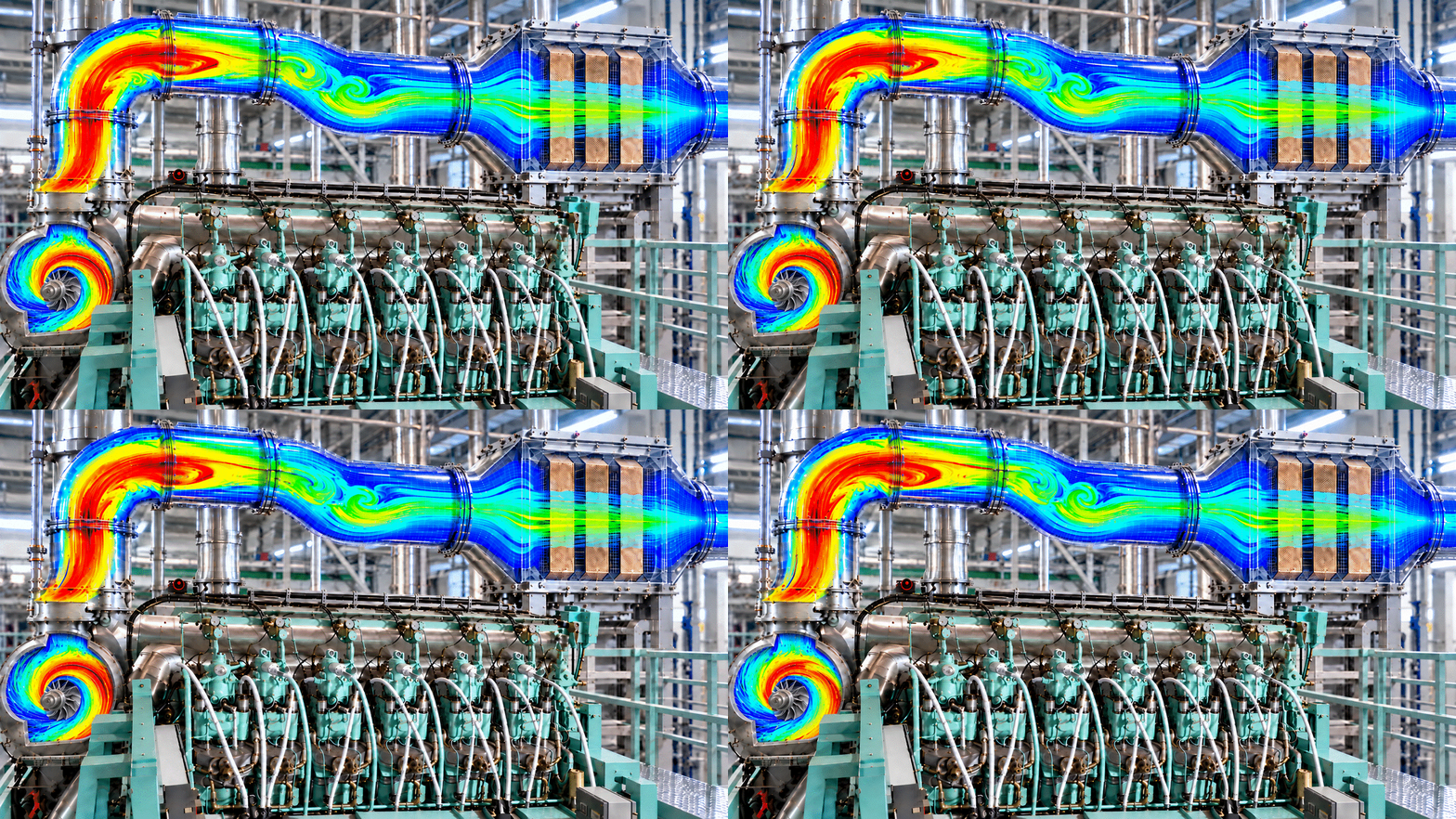
The CFD Laboratory studies fluid flow and heat transfer in mechanical and marine systems using computational fluid dynamics (CFD). We combine physics-based simulation with data-driven and AI methods to make flow analysis faster and easier to use, and apply it mainly to eco-friendly ships: engines, exhaust gas aftertreatment, and onboard carbon capture. Our work covers the whole analysis process, from geometry and meshing to solver setup, validation against experiments, and the use of results in design and operation. |
|
|
|
Computational Fluid Dynamics Hybrid AI-CFD 1D–3D Coupling Marine Engines Emission Reduction Onboard Carbon Capture |
||
Research areas
01
Hybrid AI-CFD automation
Automating the CFD workflow for internal flows in pipes, ducts, and valves: flow domain generation from CAD geometry, mesh quality control, solver runs, and extraction of design indicators. AI is applied selectively at each stage, while a conventional CFD solver handles the physics.
Flow domain generation Mesh quality Python automation Surrogate models
02
Gas flow in marine engines
Unsteady gas flow in the intake and exhaust systems of diesel and dual-fuel engines. We develop 1D–3D coupling methods that solve most of the system in 1D and only the regions of interest, such as valves, ports, and bends, in 3D, which shortens computation time while keeping detailed flow fields where they are needed.
1D–3D coupling Method of characteristics Intake and exhaust systems Valves
03
Emission reduction for eco-friendly ships
Flow and performance analysis of emission control devices such as SCR, EGR, scrubbers, and SOx/PM reduction systems, and of alternative fuel systems including LNG fuel gas supply and biodiesel blends.
SCR / EGR SOx / PM LNG fuel Biodiesel
04
Onboard carbon capture (OCCS)
Engine, exhaust aftertreatment, CO2 capture, and waste heat recovery designed as one energy system. Topics include gas–liquid flow in absorbers, capture performance under variable engine load and cold-climate operation such as Arctic routes, onboard liquefied CO2 storage, and energy consumption assessment for regulatory verification.
Carbon capture Two-phase flow Waste heat recovery MRV
05
Data-driven modeling and monitoring
Prediction and optimization models built from experimental and simulation data, such as multivariate regression and multi-objective optimization of engine fuel use and emissions, and pressure sensor-based condition diagnosis and predictive maintenance of marine equipment.
Regression models Multi-objective optimization Condition monitoring Predictive maintenance
How we work
SIMULATION
3D CFD with commercial and open-source codes, 1D system analysis, and in-house coupling algorithms.
DATA & AI
Datasets from simulations and experiments, surrogate models, and workflow automation in Python.
VALIDATION
Engine test facility and exhaust gas measurement, with simulation results checked against measured data.
What you will learn
CFD from start to finish
Geometry preparation, meshing and mesh quality, boundary conditions, turbulence and multiphase models, solving, and post-processing.
Numerical methods and coding
Writing your own solvers and user-defined functions, automating CFD with Python, and working with open-source codes such as OpenFOAM.
AI and data-driven modeling
Building datasets from simulations and experiments, training surrogate models, and using them for prediction and optimization.
Marine engines and emission control
How engines, exhaust aftertreatment, and carbon capture systems work, and the IMO regulations that shape their design.
Experiments and validation
Engine and exhaust gas measurements, and comparison of simulation results with experimental data.
Research and communication
Planning a study, writing journal papers, and presenting results at domestic and international conferences.
Career paths
As a new laboratory, we are forming our first research group. The skills developed here apply directly to the following fields.
Shipbuilding and offshore
Design and R&D at shipyards, especially eco-friendly ships and alternative fuel systems.
Marine engines and equipment
Manufacturers of engines, exhaust aftertreatment, fuel gas supply, and carbon capture systems.
Classification and certification
Classification societies and testing and certification bodies dealing with emission and carbon capture regulations.
CAE and simulation engineering
CFD software and engineering service companies, and simulation teams in manufacturing.
Energy, automotive, and plants
Power and energy systems, hydrogen, HVAC, automotive powertrains, and process plants.
Research and academia
Government research institutes, corporate R&D centers, and doctoral or postdoctoral research.
Join the CFD Laboratory
We welcome graduate students (M.S. and Ph.D.) and undergraduate researchers interested in fluid mechanics, heat transfer, marine engines, or programming.
Prospective students are encouraged to contact the professor by email at kjkong@pknu.ac.kr